
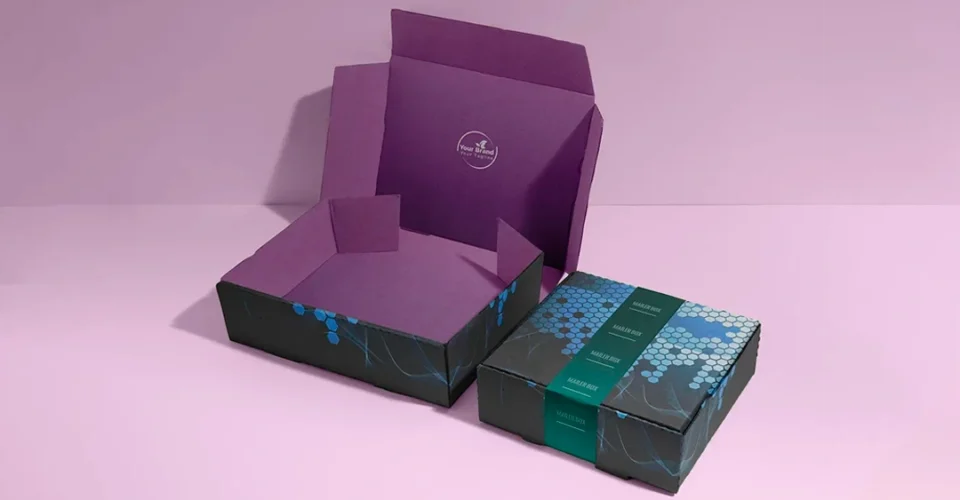
For a fast-moving UAE e-commerce brand, the right packaging supply model depends on how stable demand is, how many sizes you run, and what warehouse space actually costs you. Buying custom mailer boxes wholesale lowers unit cost and protects against stockouts. Just-in-time ordering frees up cash and avoids obsolete stock when designs change often.
At thirty orders a month, packaging is a purchase. At three hundred a day it is an inventory line with a lead time, a storage cost, and a way of going wrong during your busiest week.
The question stops being where to find a cheap box and becomes when to buy, how much to hold, and which sizes deserve the floor space. Run out during a campaign and dispatches slow down. Over-order the wrong size and the cash sits in a corner of the warehouse in cartons that no longer fit the product range.
What actually changes between the two models
The two models solve different problems. Wholesale buys availability and unit economics. Just-in-time buys flexibility and a smaller inventory exposure.
| Factor | Mailer boxes wholesale | Just-in-time ordering |
| Unit cost | Better at higher quantities | Higher per order |
| Storage requirement | Higher | Lower |
| Risk of overstock | Higher | Lower |
| Protection from supplier delays | Better | Depends on replenishment holding up |
| Best for | Stable, high-volume SKUs | Changing or unpredictable demand |
| Cash commitment | Higher upfront | Spread across orders |
| SKU flexibility | Lower once several sizes are stocked | Higher |
Neither is the correct answer on its own. What decides it is how your packaging demand behaves, and most brands have some SKUs behaving one way and some the other.
When mailer boxes wholesale make sense
Wholesale works when demand is predictable across a small number of sizes. An apparel brand shipping thousands of similar orders a month, where most products fit two box sizes, gets a simpler packing bench and far fewer purchasing decisions out of holding stock.
The unit-cost advantage is real. Printed die-cut mailers usually carry a minimum order in the hundreds or low thousands, and the price per box drops sharply above that. The lowest quoted price still is not the lowest total cost. Storage, handling, boxes that never get used and the redesign you do in eight months all belong in the same calculation.
That last one is the specific risk with custom mailer boxes. A large run stops being economical the moment the branding, the dimensions or the product assortment changes before the stock runs out, and plenty of brands outgrow a box design faster than they get through 5,000 of them.
When just-in-time is the smarter option
Just-in-time suits brands whose range moves. A beauty retailer launching new SKUs every quarter may find that a box fitting perfectly today is wrong after one reformulation or a bundle change. Ordering closer to the point of need keeps obsolete packaging out of the building.
It also protects working capital. Rather than paying for four months of packaging at once, the spend spreads across shorter cycles, which matters when the same cash could be buying stock that actually sells.
The trade-off is that replenishment has to be dependable. Printed mailers typically take a few weeks from artwork approval to delivery, longer when they are produced offshore and shipped in. Long lead times plus a sudden jump in demand turns a lean inventory into a fulfilment problem fast.
Don’t compare box prices without looking at size
Procurement often compares box prices in isolation from what those boxes cost to ship.
Many carriers bill on volumetric weight, commonly calculated as length times width times height divided by 5000, and charge whichever comes out higher against the actual weight. A box 3cm oversized in each dimension pays that difference on every order for as long as you use it. Shopify makes a related point about entering accurate outside package dimensions, since those measurements feed the rate calculation.
A slightly more expensive box that fits the product properly can be the cheaper one by the end of the month.
With kraft mailer boxes the same logic holds. The natural kraft finish is an aesthetic decision, while the dimensions, the protection, the inserts and how fast the box assembles at the packing bench are operational ones. Settle both in the same conversation.
Sort your SKUs before choosing a model
Pull the last three to six months of orders and split products into three groups: consistent high-volume sellers, moderate movers, and unpredictable or seasonal items.
High-volume products are the ones worth holding bulk packaging for. Variable products suit shorter, more frequent cycles. Most brands land on a hybrid, with several months of cover on the two or three fastest-moving sizes and specialty sizes ordered closer to need.
UAE demand patterns sharpen this. Ramadan and Eid, White Friday and Dubai Shopping Festival all produce spikes that are predictable in timing and unpredictable in size. Packaging for a peak has to be ordered well before the peak arrives, which makes it a wholesale decision even for a brand that otherwise runs lean all year.
Storage versus speed
Warehouse space costs more than the rent per square metre suggests. A pallet of flat mailers takes a footprint, and it also shapes picking routes, the packing area layout, and how much time staff spend shifting supplies. In a smaller operation, packaging inventory competes with product inventory for the same floor.
Storage conditions matter as well. Corrugated absorbs moisture and loses rigidity, so cartons kept in a unit without climate control through a Dubai summer can reach the packing bench softer than they left the factory.
Cutting inventory too far produces the opposite failure, with staff waiting on packaging while orders queue. A defined reorder point handles most of this: average daily usage multiplied by supplier lead time, plus a buffer for the weeks when sales spike. For businesses working with custom mailer boxes wholesale, that one number triggers the next run before anything becomes urgent.
How customisation changes the answer
A plain logo box can stay relevant for years. A campaign design, a seasonal message, a promotional QR code or limited-edition artwork has a much shorter life, sometimes a single quarter.
Brands using custom mailer boxes should decide which category a design falls into before committing to a quantity. Evergreen branding is safe to buy in volume. Anything tied to a campaign is better produced in shorter runs even at a worse unit price, since the alternative is paying storage on boxes advertising a promotion that finished.
Color Print’s range covers packaging alongside commercial printing, branding and 3D signage, with mailer boxes listed under retail packaging, plus large-format printing and labels. Producing packaging and retail branding through the same supplier also means one colour reference across all of it rather than several.
Practical tips before choosing
- Start from actual packaging consumption, not a sales forecast.
- Work out how many weeks of cover each size represents at current volumes.
- Compare the full cost of bulk against shorter cycles, including storage and write-offs.
- Set a reorder point per size, and give someone the job of watching it.
- Check whether kraft suits the brand year-round or only one product line.
- Resist creating ten sizes when three cover most orders. Every extra size multiplies the purchasing, storage and picking work.
Frequently asked questions
Are custom mailer boxes wholesale always cheaper?
The unit price usually is. Whether the total cost is depends on storage, unused stock, how often the design changes, and how fast the inventory turns over.
Is just-in-time packaging suitable for new e-commerce brands?
Often, since volumes are uncertain and the cash is better spent on sellable stock. The requirement is a replenishment process you can actually rely on.
How many mailer box sizes should a brand stock?
Fewer than most brands run. Start with the smallest set covering your main product dimensions without leaving large voids, because void space costs money once volumetric billing applies.
Are kraft mailer boxes suitable for premium brands?
Yes, when the material, print, structure and finish match the positioning. Kraft reads as considered or as cheap depending almost entirely on execution.
Can a business run both models?
Most mature operations do. Hold stock on predictable high-volume sizes and replenish seasonal or specialty boxes closer to demand.
Should packaging be part of demand planning?
It should be. A packaging shortage halts dispatches exactly as effectively as a product shortage, and it is the one nobody has on a dashboard.
Conclusion
The lowest unit price and the leanest inventory are both easy to optimise for and neither one is the goal. What works is matching purchase frequency to how each SKU behaves, holding depth where demand is steady and staying flexible where it is not.
Multiple Packages helps businesses approach packaging decisions with this same balance in mind, so they can stock the box sizes they regularly need without overcommitting to packaging that may become outdated. So, which of your box sizes have you reordered unchanged for the last year, and which ones have quietly gone obsolete in the corner of the warehouse?