
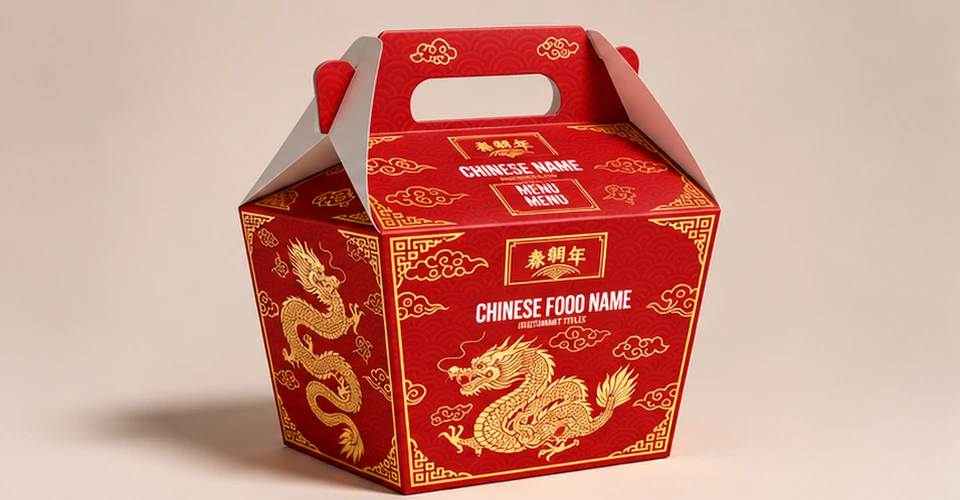
Chinese takeout boxes will help keep your fried snacks crisp as the vents will allow the steam to escape without being blocked by the folds, stacked cartons or the delivery bag. You want the vents positioned above the food, you want to protect the greasy base, and you’ll want to test the whole packed order. Venting will reduce the amount of trapped moisture but won’t fix soggy food or poor handling.
A customer orders spring rolls and fried wontons. They leave the kitchen crisp, arrive soft and damp twenty minutes later. The first port of call might be the recipe. It’s quite common for problems to arise after the lid’s closed. Hot food gives off moisture and that vapour will condense against the cooler packaging.
Why fried snacks soften inside a closed carton
Steam from the freshly cooked food will increase the humidity inside the box. You’ll get condensation on the lid and/or the upper walls which will either drip or simply transfer moisture back to the snacks.
For Chinese takeout boxes, it’s all about controlled ventilation. You don’t want the food to be in contact with the box itself (i.e. not pressed hard against the top) and you don’t want any oil to escape.
Put the vents in positions where the escaping steam has a clear path.
Small apertures near an upper sidewall or above the food level can provide a route for any rising moisture to escape. Don’t put them in the base where oil could leak, or right through any of the structural folds which are going to have to carry the weight of a full carton.
Detpak’s food delivery packaging guide refers to a carton concept which has reduced air ingress and upper steam exit. It doesn’t necessarily follow that every takeaway box will need holes at both ends. The right configuration will depend on the food, the box shape, the level of grease and how it’s going to be transported.
Check the closure prior to cutting the board.
A vent covered by an interlocking flap is purely decorative. On the traditional folded Chinese takeout boxes, you need to check the final closed shape (handles and the overlapping top panels in particular). Slots should be kept well away from locking points and areas where the customer will be gripping the package. A vent can also be a weak point if it’s too close to a score line.
The delivery bag can cancel a good vent design.
A carton that vents well on a test bench may well fail to vent when actually inside a tightly closed delivery bag. Steam can build up around several hot containers, particularly if the cartons are in close proximity to each other or if they’re all surrounded by a plastic liner.
Test the real loading pattern: two boxes side by side, one on top of the other with the sauces and drinks in the position they would be in for a real order. The top vent could be covered by the box above it. A side vent could be facing a bag wall.
Compare common vent layouts.
| Vent layout | Potential advantage | What to test |
|---|---|---|
| Small upper-side slots | Steam can leave below the closed top | Bag-wall contact and grease splash |
| Openings near the lid | Short escape path for rising vapor | Flap overlap, stickers, and stacking |
| Low and high openings | May encourage airflow through the carton | Oil leakage, contamination exposure, and structural strength |
There’s no vent pattern that will guarantee crispness. You need to record the food texture and the level of condensation after the same journey for each prototype.
Grease resistance and food contact remain the priority.
Vents should not be used to compensate for poor paperboard. Fried snacks will come into contact with the base and the sides so the food contact surface has to be appropriate for the fat content, duration and temperature of the food. The FDA go on to say that substances in food packaging (including certain coatings and adhesives) are regulated in accordance with their intended use.
Ask for evidence to support the material specification rather than just take a ‘food grade’ claim on board. Find out if a compatible liner is required and whether that liner will stay flat rather than block the air path.
Why listings for vape boxes for sale aren’t food packaging
Online packaging catalogs can have food cartons placed next to listings for vape boxes for sale. They can both be made from printed paperboard. A similar outline in no way implies that a non-food carton is suitable for use with hot oily foods.
A product that’s described as “vape boxes for sale” could well have its finishes, adhesives and internal surfaces chosen for a completely different reason. For restaurant orders you’d want to approve the materials for food contact and then test the ventilation with the actual fried product.
Run a practical delivery test prior to placing an order.
Pack the same quantity of the fried snacks into three prototype cartons. Same preparation and packing as normal, then just follow the normal delivery route with the real bag and the surrounding goods. Open each box at the normal time of arrival and record:
- Whether moisture collected on the lid or touched the food
- Whether the vent remained exposed throughout the trip
- Whether grease marked the outside or weakened a fold
- Whether the snacks stayed acceptably crisp and warm
- Whether drivers could carry and stack the order safely
Repeat the trial during a busy service period when the containers are being filled quickly and the bags are full. If one sample is a poor performer then work out whether the problem is vent position, portion size, food prep or the outer bag before going and ordering a different board.
Give the supplier the full order not just a box size.
When talking about Chinese takeout boxes, share the menu item, the portion weight, the fill temp, the estimated travel time, the bag type, the stacking arrangement and any tamper seal placement. Include both the intended printed artwork and the food contact requirements.
Multiple Packages offer custom food cartons for US restaurants and delivery brands. Get a production style sample with the proposed vent layout and material spec and then compare the performance prior to approving the wholesale quantity.
Frequently asked questions
Do vent holes always keep the fried food crispy?
No, they’ll help to reduce the amount of trapped steam, though the effect will vary depending on the recipe, the fill level, the time of delivery and whether the openings stay clear.
Where should the vents be on the Chinese takeout boxes?
Test the upper sidewalls or the areas adjacent to the lid. Obviously don’t do this if the closures, the other boxes or the delivery bag are in the way.
Can a tightly sealed delivery bag make food soggy?
It can trap moisture around the hot cartons. You’ll need to test the whole packed order rather than just judge a container on its own.
Can cartons that are listed as vape boxes for sale be used for fried snacks?
Don’t assume so. Their materials and their intended uses are different. Choose packaging that has been verified for contact with hot, fatty food.
Should the sauces go in the same carton?
For crisp snacks a separate suitable sauce container is normally the easier way to achieve good moisture control and minimises contact with the fried coating.
Test the vent once the bag is closed.
Good Chinese takeout boxes will have a good balance of steam vent and grease control. They’ll be robust enough to be stacked and handled without issue. They’ll have a fairly distinct restaurant look about them. The position of a small vent may be more important than the size of it once you’ve got a stack of orders to deal with. When your next delivery of fried snacks is completely full, is steam still going to be able to escape?