
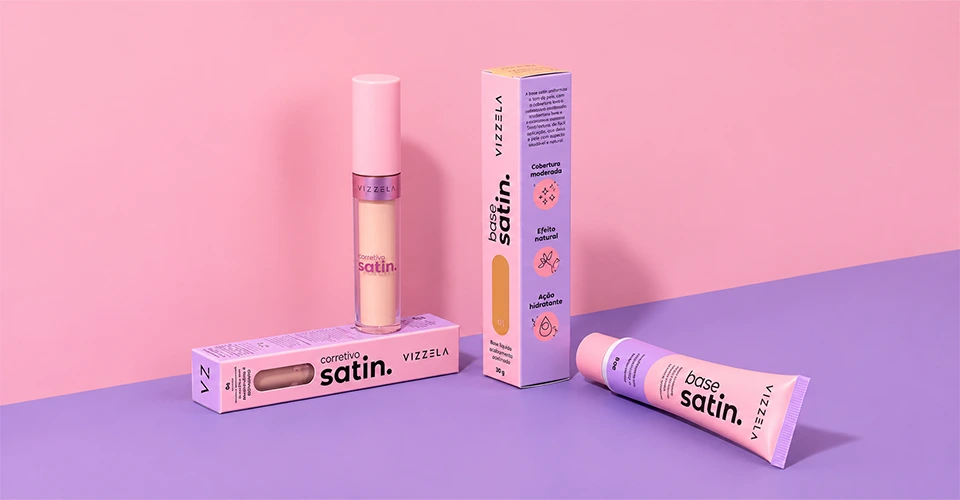
When designing Makeup Packaging Boxes, position a display window for your dual-ended concealer pen around the fully assembled product rather than at an assumed midpoint. If one cap is longer then a central cutout may end up revealing the wrong detail or the pen will look unbalanced. Measure both capped ends, hold the pen in position and test the window once the carton is assembled.
A dual ended concealer pen may appear symmetrical in the mockup but in reality the finished pack will be different. One of the protective caps may be longer, wider or more rounded. If you cut a window around an idealised centreline the visible barrel will appear to be offset once the pen is packed.
Measure the whole pen before you draw the window.
Start with a fully filled, closed production sample. Record the overall length, the maximum diameter and the individual cap dimensions. Note any raised collar, clip or decorative band which will affect the way the pen sits in the insert. Check some units for closure variation.
Some dual-ended designs will have two different formulas or two different applicators. Choebe’s B112 range is a good example of how you can have two ended cosmetic pen assemblies with quite different internal make ups. Don’t go and borrow another supplier’s dimensions for your dieline. Use the actual approved pen.
For makeup packaging boxes, you’d measure the visible length of the barrel between the caps. That length may have a different center to the full product and is often a useful reference point for a narrow viewing window.
What unequal cap lengths change on the front panel
A window positioned to show the carton will reveal more of the long cap and less of the decorated barrel. The shopper may end up seeing the plastic rather than the shade or the defining feature.
An offset window can correct the view but you can end up with a weak panel or a very difficult film attachment if you’re right up against a side score or tuck flap.
A makeup packaging box still has to have the product information legible of course. Don’t just go in and blow out a window to fill the panel.
Compare three display-window approaches.
| Window approach | When it works | Main risk to test |
| Narrow barrel-centered window | The decorated barrel tells the product story | Pen rotation or an off-center view |
| Offset window toward the shorter cap | One feature near that end needs visibility | Cutout near a score or closure |
| Larger window showing both ends | Both applicators matter to the purchase | Reduced print area and exposed insert edges |
A transparent film covers the opening, but it doesn’t stop the pen from sliding inside the carton. The insert must handle restraint separately.
Keep the long cap from taking the load.
A longer cap can end up being the first point of contact when the box is tipped or dropped. If an insert is pressing on that cap to secure the pen it could in effect loosen the cap or leave a scuff. Rather, support the central barrel or some other appropriate rigid section (as long as the unit will allow it).
Try a slim folded paperboard cradle with retention points that clear both cap joins. Incorporate a finger recess so the pen can be lifted by the user without having to pull on the cap. Turn the prototype over to check that the visible section is still nicely framed.
This is the same general fit issue that you see with nail polish boxes (the tall closure affects the carton) and with the lipstick boxes packaging, where you have a separate outer cap and mechanism which need different support. The dimensions of the two are not the same.
Don’t trade the required labeling for a bigger window.
A wide cutout can look very impressive in a design mock-up and yet leave very little actual panel for product identity and net quantity. For cosmetics sold in the US the FDA labeling summary makes it clear that the principal display panel of the outer container must carry the required identity and net contents information and other required information must be appropriately positioned.
Review the regulatory copy prior to approving the dieline. Keep any small text well away from cut outs and creases. For the two formulae, have the brand reviewer check the contents and ingredient declarations.
A makeup packaging box should also enable accurate shade identification. A transparent cap won’t necessarily reveal the true formula color; if the product is opaque then a clearly printed shade name or an approved swatch may be more reliable than a large window.
Compare the related beauty carton specifications.
Lots of brands will buy concealer cartons in conjunction with their nail polish boxes and lipstick boxes packaging as part of a co-branded launch. You can have shared colors, shared finishes and shared supplier artwork templates to help maintain a consistent line. Each individual item of course still needs its own physical fit approval.
For the nail polish boxes we need to check neck and cap clearance as well as the weight of the filled bottle. For the lipstick boxes packaging we need to check the assembled cap and how the tube comes out. The dual ended concealer pen requires particular attention to orientation as the correct end must be visible to the shopper after normal use.
One branding system doesn’t necessarily imply identical window positions or inserts.
Approve the filled prototype, not only the dieline
Before you go ahead and order a production run, test the final board, the film, the insert, the printed finish and the fully assembled pen all together. Pack up several samples in the master carton as you would for a production run.
Check four things: window alignment on assembly; cap contact with lid and insert; product movement during handling; and legibility of all retail information. Check the film for adhesive marks and the decorated pen for scratches. If the longer cap is progressively coming into view then re-tighten the restraint prior to enlarging the window.
Multiple Packages offers custom beauty-carton styles, including window and insert options for US cosmetic brands. When requesting a sample of a makeup packaging box, send the exact finished pen and approved front-panel artwork so we can review structural fit and presentation together.
Frequently asked questions
Should the window be centered on the concealer carton?
Not necessarily. Center it around the feature customers need to see, then confirm its position against the fully capped pen and finished box.
Does window film prevent the pen from shifting?
No. The film closes the opening; a fitted insert or other suitable restraint controls movement.
Can both applicator ends appear in one window?
Yes, but test the larger cutout for carton strength, print space, and whether both ends remain visible after packing.
Can one insert work for several concealer shades?
Often, if the container dimensions are identical. Approve any changes to caps, collars, or applicator tips before reordering.
What should a final packaging sample confirm?
Correct orientation, cap clearance, window-film attachment, label readability, and protection during expected handling and shipping.
Let the product determine the window.
A display opening should make a dual-ended concealer easier to understand without creating a fragile carton or a loose fit. The best makeup packaging box puts the pen’s important feature in view, supports it without squeezing either cap, and leaves room for required artwork. Before approving the next window cut, have you checked where the actual capped pen will sit?