
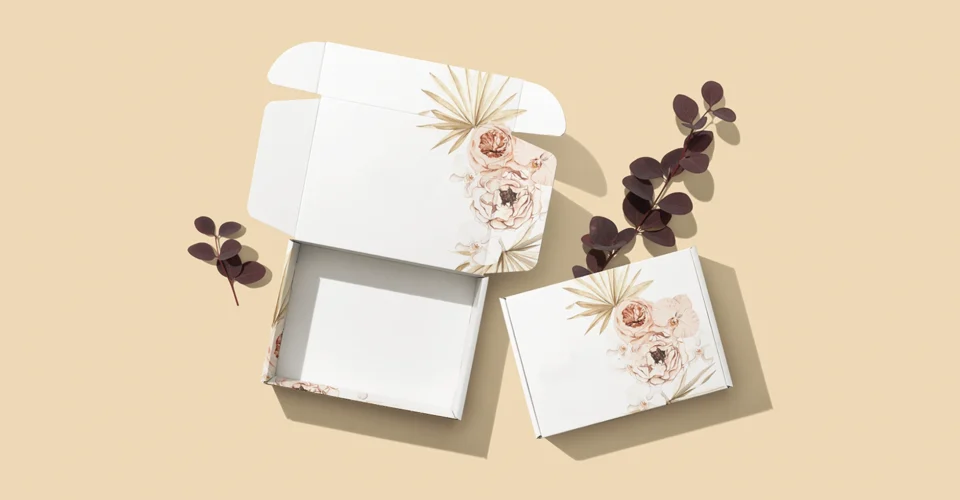
Ceramic tiles often use custom mailer boxes for testing samples that need a supported gap between the tile edges. The carton walls facilitate a large cavity filled with loose padding. Measure the finished tile, fix it in place with a fitted insert and test the full parcel. Supported clearance provides the necessary cushioning to take the impact; excess space would allow a fragile sample to move.
A chipped corner will completely kill a sample presentation in the eyes of an architect or homeowner before they’ve even seen the glaze. The tile may be the right colour all right, but a chipped edge indicates the brand didn’t do anything to prepare for delivery. Oversizing the parcel seems like a sensible precaution, but it can in fact create a different problem.
Begin With the Tile, Not a Standard Box Size
Ceramic samples are not interchangeable squares. One set might have a very thin glazed wall tile, another might have a much heavier porcelain with sharp rectified edges. Record the actual dimensions (length, width, thickness) and weight of the sample, including any mounting board or sample label.
A bevelled edge requires a different kind of support to a clean crisp square edge. Design around real production variation rather than someone showroom piece.
Exploring internal dimensions for external supports which are used for the shipping quotes. Folds and inserts will take up space.
What does edge clearance actually do?
Clearance allows the cushioning to take the impact before the wall even gets to the ceramic. An open gap is different in that a loose tile can actually hit the wall quite hard.
A folded corrugated cradle will keep the sample centred and provide an edge buffer. Corner pads may be used for a single piece (as long as they don’t slip off). For multiple samples you’d need to separate the faces so the gritty back of one doesn’t scratch the glazed face of another.
Protect the face in a different way to the edges. A non-abrasive separator will stop the surface rubbing, a structural insert will carry the weight of the tile.
Compare Common Packing Approaches
| Packing Method | Best Use | What to Watch |
| Loose paper cushioning | Irregular pieces and small trials | Shifting and inconsistent corner coverage |
| Folded corrugated insert | Repeat orders in fixed tile sizes | Incorrect scores or exposed hard contact points |
| Fitted corner protectors | Single samples with fragile edges | Pads slipping during handling |
Why Oversized Custom Mailer Boxes Can Cost More
Shipping charges are not simply based on scale weight. FedEx has a concept of dimensional weight which is a calculation of the volume of the parcel. Depending on the service you choose, a large, light package can be charged as if it were heavier.
An extra inch of height will give you more board, more filler and more storage space.
The answer isn’t to shave every fraction of an inch off the box.
Build a Better Sample Kit for Specifiers
Architects will often get a number of finishes. You need to keep every sample identifiable without having a pile of loose tiles.
For a multi-tile kit use separate slots or sleeves in a supported tray. Ensure the finish codes are readable so that each piece can be matched to its specification sheet. With custom mailers the info card can be positioned above the tray and won’t end up as loose filler.
Custom mailing packages should open without any tools scraping the glaze. Keep the pull tabs well away from the insert and the shipping labels on the flat outer panels.
Test the Packed Parcel, Not Just the Dieline
USPS packaging guidance is that you need strong containers, the right amount of cushioning and sufficient restraint to stop the contents from shifting. Start with a complete shipment (actual tile, insert, printed mailer and any outer protective layer).
After representative handling check for corner chips, cracks, surface rubbing and insert movement. A simple shake may reveal obvious looseness but that doesn’t in any way replace proper distribution testing. For the standard parcel programme ISTA Procedure 3A is a relevant procedure for testing products packed for parcel delivery.
What to Send a Custom Mailing Packages Supplier
A clear brief should contain the finished tile dimensions, the weights, the edge profiles, the sample count, the expected shipping routes and the artwork. You’d compare two structures on an identical brief and note the fit, the packing time, the damage and the outer dimensions.
Multiple Packages provide printed mailer styles, packaging design and prototype services. You can assess their custom mailer boxes against a physical sample and defined transit requirements rather than just go on appearance.
When you’re ordering your custom mail pack, ask for a quote that breaks down the insert, the carton material, the printing and any separate shipping protection. That way you can properly compare the true cost of the design rather than just the cost of the empty box.
Frequently Asked Questions
How much clearance does a ceramic tile need inside a mailer?
There’s no fixed ‘safe’ distance. Use a fitted protective structure and check the gap against the actual tile and the shipping conditions.
Can a tile sample ship in a paperboard mailer by itself?
Possibly if the full package is tested for the route, fragile or heavy samples will require corrugated protection and cushioning.
Will thicker corrugated board eradicate the chipped corners?
Not necessarily at all. An impact can still get through to the tile via poor contact points or a loose insert.
Are custom mailing packages more expensive than standard boxes?
They can be more expensive per unit, but the better fit may well reduce filler, wasted volume and damaged sample replacements.
What’s most important in a ceramic tile sample prototype?
Check corner protection, face separation, opening feel, outer dimensions and movement after handling.
Give Every Inch a Job
Good custom mailer boxes don’t need to be massive to look the part. They just need supported edges, good movement and a sensible footprint for the sample. Would a more clever insert be able to protect the tile whilst still keeping the shipping space under control before we go for a bigger parcel?