
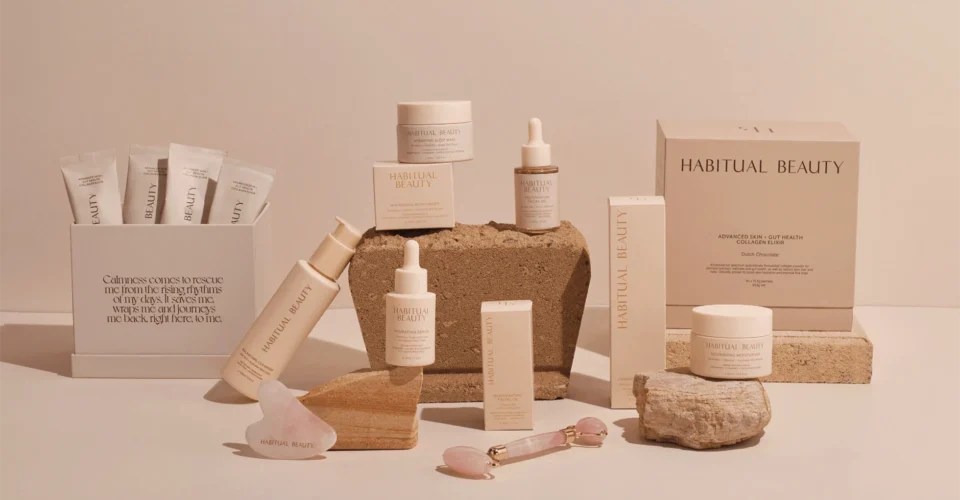
A carton for an airless serum must accommodate the fully assembled bottle (including the pump head, collar and protective cap). Custom cosmetic packaging will need to allow sufficient clearance so as not to press on the actuator when the bottle is being held steady. Measure the finished pack and check it in a physical sample prior to approving carton height.
Two serum bottles can contain the same 30ml of product and yet end up in different boxes. A curved pump head, a taller collar or a protective overcap can all take the max height of the bottle well beyond what the bottle body itself would suggest. If a brand orders their cartons from a bottle drawing without actually checking the individual pieces then you can end up with a package that’s very difficult to close or open, even if it looks absolutely fine.
Measure the bottle as the customer takes it.
Start with a fully assembled unit from the intended production line. Measure from the bottom of the bottle to the highest point of the fitted cap. If the serum ships without an overcap then measure the raised actuator in its normal shipping position. Include any decorative collars or applied labels that would affect the fit.
Don’t assume that one nominal bottle capacity translates into one external dimension. The HCP Packaging Affinity airless range is a case in point in that the actuator, collar and overcap are all separate components. You need to include those on the carton spec as well as the bottle diameter and weight.
The process inlcudes measuring several finished units samples. Ask the bottle supplier if the pump or overcap design might change between orders. A slightly different closure can impact the approved dieline even if the serum formula and fill volume are the same.
Why a tight top flap creates problems
A carton can feel snug when it’s being packed but can put pressure on a pump head once the top flap closes. That pressure can scuff a cap, bend a closure or press an unprotected actuator. Too much free space creates a different problem: the bottle can move upward when the package is handled.
Some pump suppliers actually use an overcap purely as a means of preventing accidental dispensing. TricorBraun give an example of this with one of their airless treatment pump sets. An overcap doesn’t in itself guarantee that the carton will press firmly against it; the full assembly still requires a fit test.
For custom cosmetic packaging, you need to work out which part of the package is going to do the carrying. A well designed bottom support or shoulder restraint may be all that is required to hold the bottle with no need for the lid to be pressing on the pump.
Compare three methods of managing headroom.
| Packing approach | Useful when | Check before approval |
|---|---|---|
| Direct-fit folding carton | The bottle has a secure cap and stable body | Top-flap pressure and movement |
| Folded paperboard insert | The bottle needs a lower support or shoulder stop | Insert contact with the pump |
| Taller presentation carton | A gift kit needs space for an accompanying item | Unnecessary height and shifting |
None of these structures have a universal clearance. The correct gap is going to be very much dependent on the container, the carton board and the shipping conditions.
Get the insert in place prior to increasing the carton height.
A typical response to a pump that hits the lid is to lift the whole carton. That may be necessary at times. If the bottle also rocks from side to side however, adding some extra height can make the package feel less secure.
Try a folded insert which will locate the base and leave the pump area completely free. Make sure the insert assembles quickly and doesn’t catch a label or scratch a decorated bottle. Then close the carton and gently rotate it through all the orientations it will meet during packing and shipping.
This is equally true of custom perfume boxes where the neck profile and decorative cap will impact the overall height, and of custom makeup boxes where you might have a raised applicator or a raised compact lid which will in fact stop the box closing. You have to be mindful of the highest point of the product even if the external design is the same.
Protect the design space for labelling and branding.
For custom cosmetic packaging a taller carton will change more than just the amount of board used. It can have an effect on the overall shelf profile, the position of the window and the amount of space available for product information.
The FDA’s cosmetics labelling guide states that the applicable information must be on the retail outer package (on the principal display panel) which includes the product identity and net quantity. You must confirm the labelling with your brand’s regulatory reviewer prior to finalising the artwork. The box supplier should not be making any assumptions as to which claims or warnings are applicable.
Keep the small print well clear of any folds or glued seams. If an insert is causing the bottle to move upwards then make sure that a display opening still appropriately frames the section of container you want to be seen. Premium artwork won’t save you if the pump head is actually rubbing against the inside of the lid.
Order by the finished specification, not a shared template
Beauty brands will often try to standardise the packaging across their skincare and fragrance ranges. That can be a big advantage in terms of making it easier for people to buy, provided the products actually fit. A custom perfume boxes may well need extra support for the weight of the glass whereas a custom makeup box may require a tray with a number of compartments. You can’t just take the outside dimensions of a serum and assume that will save you money.
When you’re getting custom cosmetic packaging quotes, you need to supply the assembled bottle, the component references, the printed artwork, the insert (if any) and the way you intend to pack it. Ask for a finished prototype rather than a flat digital proof. You’ll also need to record the approved internal dimensions and the bottle/component revision for future reorders.
Multiple Packages provide custom serum boxes for US beauty and skincare brands. It’s far more useful to talk through the finished pump bottle and the required carton structure than it is to simply pick a stock size based on how it looks.
If a brand is also buying custom perfume boxes and custom makeup boxes then you should have separate fit approvals for each product family even if the printing finishes are the same. Consistent branding doesn’t mean you have to have the same internal construction.
Frequently asked questions
How much space should be left above an airless pump?
There is no such thing as a universal safe allowance. Test the assembled bottle with the intended cap, insert and carton closure.
Can an airless pump accidentally discharge inside a carton?
It may be if the actuator is exposed and pressed. Make sure the pump you’ve selected has an appropriate lock or protective overcap.
Does a taller box always offer better protection for the bottle?
No. A taller box with no restraint will allow more movement. Support and clearance have to work in conjunction.
Can one carton hold several serum bottle sizes?
Possibly with purpose designed inserts. Have to approve each bottle and closure combination individually.
What should a packaging prototype contain?
A prototype shoudl look presentable alongwith the filled bottle, final closure, proposed insert, printed board and intended shipping configuration.
Make the clearance decision prior to the print run.
The safest-looking carton is not always the tallest one. Good custom cosmetic packaging keeps the products safe and mitigate any pressure causing it delay. It also helps support the bottle, and leaves room for readable branding. Before approving your next serum box, have you tested the fully assembled pump inside the finished carton?